5 August 2026 · Document ReceivedSource: document emailed to this site and the resident committee, 2 August 2026
Dr. Twaddell sent a 21-page strategy document. It is published in full, and its claims are checked.
On Sunday 2 August, a document titled “Comprehensive Briefing Brief & Master Strategy Document,” authored by Dr. Robert Twaddell, arrived by email — sent to this site, to the resident committee's convener, and to the committee's shared address, attached to a message asking the committee to help deliver 2,000 petition signatures within 30 days. This site spent two months asking for documents. When one arrives, the standard does not change: publish it whole, check what can be checked, characterize no one.
The full document, unedited, with a file fingerprint anyone can verify, is now on a dedicated page: The Briefing Document, Published in Full. Three things on that page are worth a resident's time:
Two statements, one document. Its survey introduction tells residents the petition phase “has paused.” Its operational sections direct canvassers to “hit the field immediately,” set a 2,400-signature target, and schedule collection at the 20 August school open houses. Both passages are quoted side by side, without comment.
The claims, checked. Nine checks against North Carolina statute and the document's own tables, each one repeatable by anyone with a link to ncleg.gov — including the density standard the statute actually sets, a supermajority requirement that does not appear in the statute, and a monthly cost figure that omits two charges levied in the document's own revenue table.
People named, none confirmed. The document assigns roles to public officials and organizations. Appearing in someone else's document is not evidence of agreement, endorsement, or awareness; every named role is marked unconfirmed unless the person named says otherwise, publicly or to this site directly.
Whether and on what terms the resident committee works with the document's author is that committee's decision, and it belongs to the people in that room. If anything on the page is wrong, tell us: corrections are posted within 48 hours, as always.
Update · later on 5 August 2026
After this entry was posted, the document's author asserted copyright over the document in a Facebook message to a member of the resident committee. The complete copy has been replaced on the page with the quoted excerpts necessary for verification and a page-by-page account of its contents. Every check stands unchanged, and this entry is preserved as written. The complete document remains in the inboxes of the full committee list, to whom the author sent it on 2 August.
The petition's status and the pause announcement: Petition On Hold.
The resident committee and its ground rules: Committee.
24 July 2026 · Press CoverageSources: BizFayetteville, WKML, Foxy99, CityView NC, Fayetteville Observer · retrieved 24 July 2026
A week of coverage: the pause makes the news, and the incorporation committee says what it plans next.
Since the July 16 meeting, five local outlets have covered where Gray's Creek stands. The most consequential item is a written statement from the incorporation committee itself: signature collection is deliberately paused, and the committee plans workshops with its critics. Here is the record, dated and linked.
What the incorporation committee said, in its own words
In an announcement published by BizFayetteville on 21 July, the committee said it has paused its signature petition effort to hold collaborative workshops on three topics: municipal boundaries and annexation, the cost of police protection, and zoning to preserve rural character, with schedules to be published the following week. The committee chair is quoted:
Dr. Robb Twaddell, in the committee's announcement, BizFayetteville, 21 July 2026
"We want a town built on consensus, not division. By slowing down, we can sit at the same table with critics, address valid concerns, and collaboratively design a framework that protects Gray's Creek without creating unnecessary tax burdens."
This is the committee's first written statement since the meeting, and it matters for the record in two ways. It confirms in print what the chair told the room on July 16: the petition is paused, not ended. And it makes clear the effort is not dormant: the committee intends to keep refining its proposal through workshops. Our status page has been updated accordingly.
We annotate only what we have read in full. Items listed by headline will get annotations if and when we can read them; if any outlet's coverage contradicts something on this site, that gets said here, dated.
One table, or two?
Put the committee's statement next to what is already underway here, and Gray's Creek now has two efforts speaking the same language: an open table, critics welcome, consensus before signatures. That is a good problem. The resident committee was formed for exactly this conversation, its ground rules already welcome everyone from both sides of the petition question, and its table does not belong to either side. If the incorporation committee's workshops and the resident committee's open meetings become one process instead of two, the community loses nothing but a scheduling conflict. The door on this side is open.
The petition's status, now with the committee's written statement: Petition On Hold.
The resident committee, its ground rules, and the signup: Committee.
How this fight got here: The Breakdown, parts 1 to 3.
21 July 2026 · StatusSource: statement by the committee chair, township meeting, Paradise Acres, 16 July 2026
The incorporation petition is on hold. The problem it tried to solve is not.
At the July 16 township meeting, in front of the assembled room, the committee chair stated that the petition effort is being put on hold. The full accounting of what that means, and does not mean, is now a permanent page: The Petition Is On Hold. The short version: nothing was ever filed, "on hold" is not "withdrawn," collected signatures stay with the committee, and the November 1 deadline no longer drives anything.
The promised breakdown is published
On meeting night we promised a full breakdown of what happened and how two months of effort came apart. It is published in three parts: the meeting (why a full room and a strong lineup could not save a finished plan), the two months (the two budgets, the in-preparation documents, the claims that outran the statutes), and what we do now. Read any of them and tell us what we got wrong. Corrections are posted, dated, and kept.
The site has been reorganized to move forward
Everything related to the original petition, both the incorporation effort and the petition against it, now lives in one place: the Original Petition menu above. Nothing was removed or softened; the record stands page for page. The front of the site now belongs to what comes next: the resident committee, the three paths, and the ways to join in.
16 July 2026 · Editor's NoteFrom the neighbors who run this site
Hey, Gray's Creek. You did it. You showed up. Now comes the hard part.
You showed up. You filled the room. You let them know you weren't being heard. That took time on a Thursday night and the willingness to stand up in front of your neighbors and say so, and it mattered.
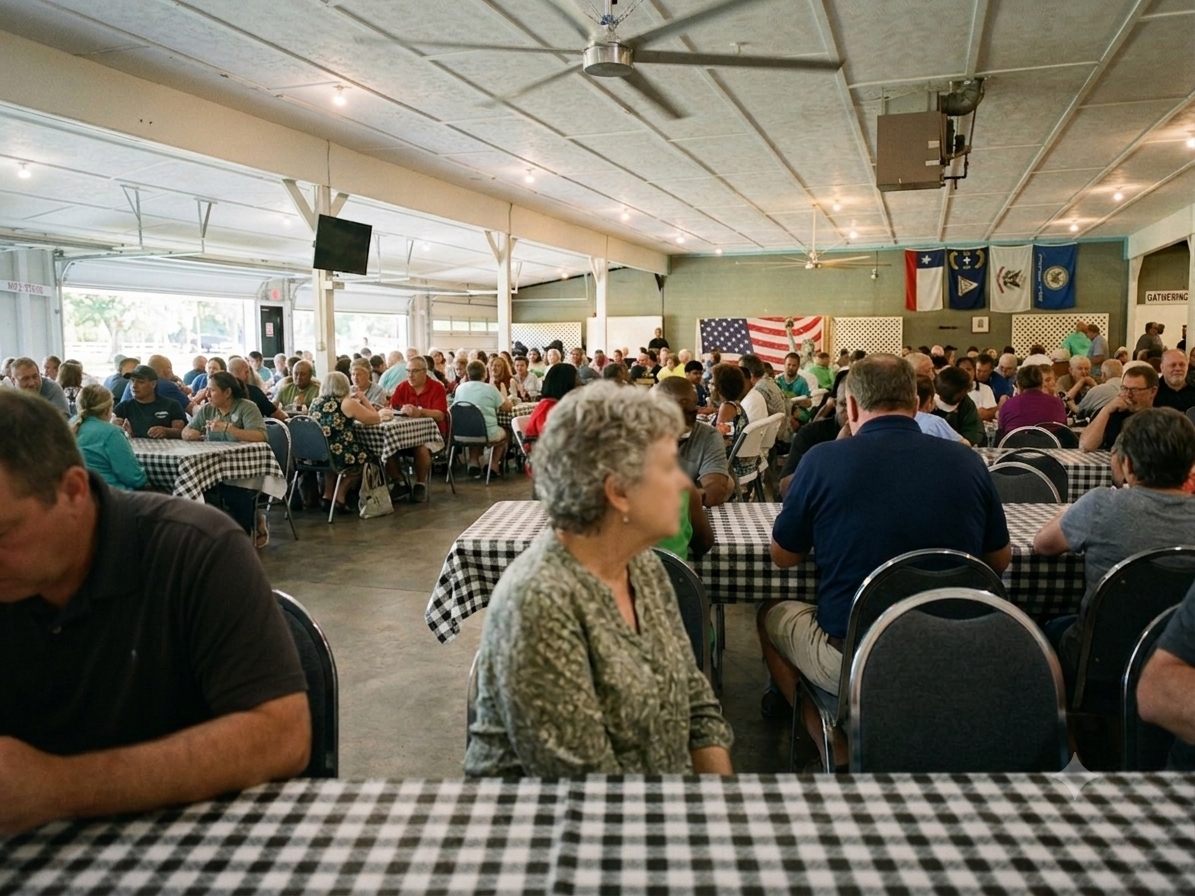
Thursday night, 16 July 2026. This image was anonymized with AI for privacy, but is based on the actual scene.
However.
We still have the same problem we had yesterday: development in Gray's Creek that is not being controlled by the people who live here. Showing up told them where we stand. It did not solve that. Nothing that happened tonight solved that.
What's coming over the next few days
Over the next few days, we will publish a breakdown of tonight's meeting and of the last couple of months of Dr. Twaddell's attempt to get out-of-control development under control: why it failed, why people are upset, and what we need to do now. As each piece goes up, we will be asking for your feedback. This only works if it runs in both directions.
This should be a cooperative process
Several people have already stepped up. That is exactly what needs to happen next, and there is room for more. Protecting this community should be a cooperative process: neighbors working it out together, in the open, not one group presenting another finished plan from a stage.
We want to hand this off
Let's be plain about what this website is. We here at Gray's Creek Facts were just people: neighbors supporting the conversation and providing information. We only ever wanted to make things known. We do not want responsibility for this community's future, and we do not want control of it. That belongs to all of us.
So let's get a group together. Form a committee, in the open, and figure out what actually works for our small rural community. And so there is no doubt about anyone's motives: the people who created and run this site plan to step away as soon as that committee is formed. The record stays public, the list below goes to the committee, and the work goes to the community it belongs to.
Put your name in for the committee
If you are willing to help form it, serve on it, or just want to be in the room when it comes together, leave your email below. This list is separate from the site's update alerts; it exists for one purpose, and it gets handed to the committee once one exists.
Cross-references
The three paths in front of Gray's Creek, and the 60-second survey, are at What Now.
Were you there tonight? The report-back form is open, and reports build the record.
15 July 2026 · Press CoverageSource: ABC11 / WTVD, Penelope Lopez, 15 July 2026
ABC11 covered the incorporation fight, with both sides on camera, the night before the signing meeting.
ABC11 / WTVD broadcast report, 15 July 2026. Video plays from abc11.com.
What the story covers
Dr. Twaddell, a Gray's Creek resident of 22 years, makes the case he has made at the community meetings: growth, the possibility of annexation, and local control of services.
Dr. Twaddell, to ABC11
"Offering the public safety, increased police protection, you know, coordinating with the fire techs and protection, deciding whether we want to contract with the county sheriff's department or establish our own small place department."
Longtime resident Donna Hultberg, one of the neighbors we connected with the station, gives the answer that shows up in nearly every conversation we have had at doors:
Donna Hultberg, to ABC11
"We just feel like we've already got the county sheriffs take care of security out here or state police, depending on the highway. We've got fire protection. We've got trash pickup. The schools are county anyway. We feel like it's just that many more taxes added on to what we already pay. ... I'm very nervous about the idea."
The story also walks through the incorporation process (petition, signatures, then the North Carolina General Assembly decides), notes Eastover as the county's most recent incorporation (2007, just under 11,000 residents), and reminds readers the next community meeting is Thursday at 6 PM, open to all residents.
Three numbers in the story worth noticing
200 signatures so far. Twaddell tells ABC11 the incorporation petition "already has 200 signatures." The legal minimum is 15% of registered voters, which the petitioners' own letter puts at 2,150, and their stated goal is 50%. By their own numbers, they are at less than a tenth of the minimum going into Thursday.
2,000 vs. 2,150. ABC11 reports 2,000 signatures are needed. The petitioners' letter to residents says 2,150. Small gap, but the letter is the primary source.
"Just under 12,000" residents. ABC11 cites census estimates putting Gray's Creek just under 12,000 people. The petitioners' materials claim "over 20,000." Those two figures cannot both describe the same proposed town, and the difference matters for every per-household number in their budget.
Why we do this
Reporters covering an incorporation need sources on both sides, and the petitioners are easy to find. The residents with questions are not, unless someone connects them. That is one of the things the Record is for: neighbors who have said publicly where they stand, and who a reporter can call. If you want to be one of them, add your name.
15 July 2026 · UpdateSource: change.org petition page, retrieved 15 July 2026
The Change.org petition now addresses the North Carolina Legislature. We have updated our pages to match.
When the independent Change.org petition appeared on 10 July, it was addressed to the Cumberland County commissioners. Its author has since corrected the address: the petition now names the North Carolina Legislature, which is the body that actually decides whether a town is created. We have updated our Petition & Record page and the meeting flyer to describe it accurately.
Why the address matters
County commissioners have no legal role in an incorporation. They can pass a resolution objecting, and legislators do notice, but the General Assembly creates towns and nothing else does. A petition aimed at the commissioners was aimed at an audience with no vote. Aimed at the legislature, it reaches the people who will decide. Our explainer on who actually decides incorporation walks through the whole process.
What we changed
Every place we described the petition as "asking the Cumberland County commissioners" now says the North Carolina Legislature: the Petition & Record page, the signature widget on this page, and the QR caption on the July 16 meeting flyer. Our 12 July entry describing the petition as first posted stays as written, with a dated note pointing here. Nothing else about the petition changed: it is still independent, still not run by this site, and still not a government filing.
15 July 2026 · ExplainerSource: N.C.G.S. Chapter 120, Article 20
Who actually decides whether a new town gets created in North Carolina?
Here is a question that sounds simple and isn't: if a group of people wants to turn their community into a town, who says yes or no?
Most folks assume it works like every other decision that affects where they live. Somebody makes a proposal, the neighbors vote, majority wins. That is not how it works. Not in North Carolina, and not even close.
The one-sentence version
A town in North Carolina exists because the General Assembly passed a law saying it exists. That's it. That's the whole thing.
Not the county commissioners. Not the Governor. Not, necessarily, the people who would live in it. The legislature in Raleigh creates towns, and a town that the legislature has not created is not a town, no matter how many people want it to be one.
Everything else in this process is a step on the way to that vote, or a way of influencing it.
The actual sequence
Step one: somebody circulates a petition.
A group of residents inside the proposed boundary gathers signatures. Under state law, they need signatures from at least 15% of the registered voters who live inside the lines they've drawn. Hold onto that number. We're coming back to it.
The petition package also includes a map of the proposed boundary, a proposed budget, and a plan for which municipal services the new town would actually provide.
Step two: a legislative commission studies it.
The petition goes to the Joint Legislative Commission on Municipal Incorporations. It looks at whether the proposal meets the standards the law sets out: Is there enough population density to be a town? Is there a real plan to deliver at least four actual municipal services? Does the budget hold up under scrutiny? Is the proposed town too close to a city that already exists?
That last one has teeth. State law sets minimum distances a new town has to keep from existing municipalities, and the bigger the nearby city, the farther away you have to be. A lot of incorporation attempts die right here, on geometry.
Step three: the commission makes a recommendation.
Favorable, unfavorable, or no recommendation at all.
Now here is the part that surprises people. That recommendation is advice. The legislature can take it or leave it. A proposal can be found deficient in every respect and still become a town if the legislature wants it to. A proposal can check every box and go nowhere if the legislature doesn't.
Step four: a legislator files a bill.
Usually one of the House or Senate members who represents the area. Incorporation bills are what's called local bills, which matters for a reason we'll get to.
Step five: the General Assembly votes.
Passes both chambers, and you have a town.
Here's the local bill part: the Governor cannot veto a local bill. There is no executive check on this. Once the legislature acts, it's done.
The 15% and the 50%: the part that actually matters
Back to those signatures.
The 15% threshold gets your petition considered. That's the price of admission.
But there's a second number, and it's the one nobody talks about at the front door.
If the petition is signed by more than 50% of the registered voters inside the proposed boundary, the legislature can incorporate the town without holding a referendum at all.
If the petition comes in between 15% and 50%, the commission can recommend that the incorporation act be submitted to a referendum, and the act can call for one. If it does, the people inside the proposed boundary get to vote on whether they want to be a town. Note the verb: can. Even in that range the referendum is discretionary, not automatic. We corrected our own site on exactly this point on 14 July.
Above 50%? The commission is barred from recommending a referendum. The legislature doesn't have to ask. It can just do it.
Why that gap should bother you
Think about what a petition signature actually is.
Somebody knocks on your door on a Saturday. They're friendly. They're your neighbor, or they say they are. They tell you they're trying to give the community a voice, keep local control, protect the area from something. They hand you a clipboard.
You sign. Maybe you agree. Maybe you half agree. Maybe you didn't read the map and don't know your property is in the boundary. Maybe you just wanted the conversation to end so you could get back to your yard.
Now think about what a vote is. Private booth. Time to read. Time to have heard the other side. Nobody watching you.
Those two things are not the same, and everyone running a petition drive knows they're not the same. Which is why a petition drive that pushes hard to clear 50% is, functionally, an effort to make sure there is never a vote.
That's not an accusation against any particular effort. It's just what the incentive structure is. The law says get to 50% and you can skip asking. So people try to get to 50%.
Which makes one boring procedural question the most important question in the entire process: how many signatures were actually gathered, and were they properly verified against the voter rolls?
Not "does this town make sense." Not "can they afford it." Those matter, but they're arguments. The signature count is arithmetic, and arithmetic is checkable.
Who doesn't get a say
Worth spelling out, because people assume otherwise:
The county commissioners. They can pass a resolution objecting. It carries political weight, and legislators do notice. But it is not a veto. It has no legal force.
The Governor. No role. Local bills bypass the veto entirely.
The neighboring towns and cities. Their interests show up in the proximity rules, but they don't get a vote.
The rest of the county. If there is a referendum, only voters inside the proposed boundary cast ballots. Your neighbors across the road from the boundary line, who will absolutely be affected by whatever the new town does, have no vote whatsoever.
The caveat that swallows the rule
Everything above describes the ordinary process, the one written into Article 20 of the statutes.
The General Assembly is not bound by it.
The legislature wrote those rules and the legislature can go around them. A local bill can incorporate a town without going through the commission at all, with whatever referendum terms the bill's author decides to write in, or with none. It has happened. It will happen again.
So the 15% and the 50% describe the normal path. They are not a wall. They are a suggestion the legislature makes to itself.
What this means if you're paying attention
The whole thing rests on a small number of people in Raleigh, and mostly on the handful who represent your area. The statutory criteria aren't a gate that swings open when you satisfy them. They're ammunition. A favorable finding is a talking point for the proponents. An unfavorable one is a talking point for the opposition. Neither one decides anything.
Which means if you care about the outcome, whichever side you're on, the leverage points are:
The signature count and its verification, because that determines whether a vote happens at all.
Your legislative delegation, because they're the ones who file the bill or don't.
Legislative leadership, because they decide whether a filed bill ever moves.
Everything else is commentary.
The uncomfortable truth is that a community can be turned into a municipality, with taxing authority over your property, by a process in which you were never asked. That's not a conspiracy. It's just what the statutes say. Most people only find out when it's already happened.
Worth knowing before it's your turn.
Cross-references
The 50% goal the Gray's Creek petitioners have set, in their own words, is in our 14 July entry.
Write to the legislators who represent Gray's Creek with our Letter to Legislator template.
Check whether your address is inside the proposed line on Am I Inside?.
14 July 2026 · Finding & CorrectionSource: N.C.G.S. 120-172; petitioners' letter to residents; grayscreeknc.com
The vote the petitioners promise is not guaranteed, and the signature goal they have set would eliminate it.
The petitioners' website tells residents that "Gray's Creek residents vote directly on incorporation," and its timeline lists "the formal vote by residents" as a step in the process. North Carolina law does not guarantee that vote. Under N.C.G.S. 120-172, a referendum is discretionary. And if the petition is signed by 50% of registered voters, which is the goal the petitioners have publicly set, the Commission is barred from recommending one.
What the statute says
N.C.G.S. 120-172 governs whether residents get to vote on an incorporation the General Assembly passes:
N.C.G.S. 120-172
"the Commission may recommend that any incorporation act passed by the General Assembly shall be submitted to a referendum, except if the petition contained the signatures of fifty percent (50%) of registered voters the Commission shall not recommend a referendum."
Two things follow. First, the referendum is permissive, not mandatory: the Commission may recommend one. Second, at 50% it is prohibited outright. The Commission shall not recommend a referendum for a petition carrying half the registered voters.
What the petitioners have set as their goal
Their letter to residents is explicit about the target, and about the fact that it is far above what the law requires:
Petitioners' letter to residents, May 2026
"The Goal: State law requires signatures from 15% of registered voters (2,150 signatures) to submit to the Legislative Commission on Municipal Incorporations. Our goal is to secure 50% to show overwhelming community support. We expect to gather many of these at our upcoming community meeting."
The stated reason for seeking 50% is to demonstrate support. The legal effect of reaching 50% is to remove the referendum. Those are two different things, and only one of them is in the letter.
Our correction
Until today, our own Am I Inside? page told residents they would become part of the new town "if the petition passes the General Assembly and a subsequent referendum." That was wrong, in the same way the petitioners' materials are wrong: it presented a discretionary referendum as an automatic one. We have corrected both places it appeared and replaced them with what the statute actually says. We repeated a claim without checking it against the statute, and it was the single most consequential claim on that page.
What to ask
This is a question for the petitioners, and it has a factual answer. How many signatures are they seeking? If the answer is still 50%, then every resident signing at Paradise Acres should be told, at the table, that reaching that number is what removes their vote. If the petitioners did not know that, they should say so. If they did, they should explain why the website still promises a "formal vote by residents."
Cross-references
Check whether your address is inside the proposed line on Am I Inside?.
Our accuracy standard and how to report an error are on Corrections.
14 July 2026 · CorrectionSource: US Census Bureau, City of Wilmington
Correction: the proposed boundary is the size of Wilmington, not larger than Wilmington.
In several places on this site and on two printed handouts, we wrote that the proposed fifty-square-mile boundary is "larger than the City of Wilmington." That is wrong. Wilmington covers about 52.6 square miles. Fifty is slightly smaller, not larger. We caught it ourselves while preparing materials for reporters, and we have corrected it everywhere it appeared.
What was wrong, and where
The claim appeared on the home page, the geography page, the materials page, the press page, and in the "Fifty Square Miles" poster and the meeting one-pager. Our own scale table on the geography page listed Wilmington correctly at 52.6 square miles the entire time, which means the site contradicted itself on the same page. That is exactly the failure we have criticized in the petitioners' materials, and it is not less of a failure when we do it.
We also corrected a second error on the same subject. Our summary page said the proposed town would have "one-eighth the people" of Wilmington. The correct figure is roughly one-sixth: about 20,000 against Wilmington's 115,000. That error overstated our own argument, which is the kind we intend to be hardest on.
What did not change
The underlying point is unchanged, and it is the point that always mattered. Fifty square miles is the geographic footprint of the City of Wilmington. Wilmington runs that footprint with about 115,000 residents, roughly 2,200 people per square mile, a deep-water port, and a full city government. The proposed Town of Gray's Creek would run a comparable footprint with about 20,000 residents at roughly 400 people per square mile. Hope Mills and Spring Lake, the two towns the petitioners cite as proof that "small towns work," are 6.5 square miles each.
"Larger than Wilmington" was never the argument. Density was. The corrected version states it more accurately and, we think, more forcefully.
Why we're posting this
Our accuracy standard says that anything shown to be wrong gets corrected quickly and visibly, and that substantive corrections go on the record rather than getting fixed quietly. Nobody reported this one to us. We found it, so we are posting it. A site that asks the petitioners to answer for their published numbers has no standing to quietly edit its own.
Cross-references
The full scale comparison and sourcing are on our Geography page.
Our accuracy standard and how to report an error are on Corrections.
14 July 2026Source: statement to Gray's Creek Facts, provided 10 July 2026
Commissioner Henry Tyson has told us directly that he is neutral on incorporation and will not take a position.
Cumberland County Commissioner Henry Tyson, who is listed as a speaker at the July 16 meeting, reached out to us on Friday, 10 July 2026 to clarify his role. He asked that his position be made clear: he is neutral, and his appearance at the meeting is to answer residents' questions, not to endorse the incorporation.
In his words:
“The County has no official position or role in incorporation. I was asked by the organizer if I would speak at the event to answer questions, and I agreed. I am neutral and will not be taking a position for or against this issue. I will follow the will of the community.”
Commissioner Henry Tyson, Cumberland County
Why we're posting this
This site's standard is that being listed as a speaker at a meeting is not a position on incorporation, for or against, and we do not present it as one. Commissioner Tyson has now stated his position directly, and it is neutral. We are glad to put it on the record so that no one mistakes his willingness to answer residents' questions for support of the proposal.
The same holds for the other officials listed on the July 16 agenda: a sitting state representative, the county sheriff, and the local fire chief. None has stated a position for or against incorporation, and appearing on the agenda does not indicate one. Any resident can ask each of them directly where they stand.
Cross-references
The July 16 meeting and full agenda are on our Meetings page.
14 July 2026Source: Robb Twaddell Facebook post, Gray's Creek community group, retrieved 14 July 2026
The petitioners have published a "case for incorporation." We answered it point by point.
Ahead of the July 16 meeting, lead petitioner Robb Twaddell posted a written "Case for Incorporation" to a community Facebook group, making the affirmative case for a Town of Gray's Creek, on taxes, zoning, water, policing, fire, and "keeping tax dollars local." We think it's good they wrote their case down, so we took it seriously and answered every claim on the facts. New page: The case for incorporation, examined.
The through-line
Almost every number in the pitch, the "$0.06 net tax," the "$1 million in recreation funding," the "millions kept local," traces back to one document that still does not exist: an independent feasibility study. Until one is published, those figures are projections the committee produced itself, not findings anyone can check.
Where their case is fair, and where it isn't
Fair: local zoning control is a real power you only get by incorporating. We say so plainly.
Already happening without a town: their own sheet concedes the county and PWC are already funding and installing the water lines. On fire protection, the district is already funded by the $0.15 tax you pay today.
Overstated: the "forced annexation" threat is much smaller under North Carolina's 2011–2012 annexation reforms than the pitch implies.
A promise, not a guarantee: "we'll stay a lean, four-pillar town" binds no future council. Scope, rate, and fees are set by whoever wins the next election.
What to do with it
Read the full point-by-point breakdown, then bring the questions to the July 16 meeting at Paradise Acres. You do not have to sign anything to attend. The organizers invited a public Q&A; this is what a Q&A is for.
A note on the meeting: the local officials listed as speakers are not for or against incorporation. Being on the agenda is not a position either way.
12 July 2026Source: change.org, petition created 10 July 2026
A resident has started an independent Change.org petition opposing the incorporation.
It is addressed to the Cumberland County commissioners and asks them to oppose the incorporation. (Update, 15 July 2026: the petition's author has since corrected the address to the North Carolina Legislature. See our entry on the change.)
It raises concerns this site also documents: new municipal property taxes and fees, an added layer of government, and the fact that policing, fire protection, and schools are already provided at the county level.
It asks that the community's rural character be preserved.
The petition is gathering names now. Signatures so far: 150+ toward a goal of 200. The count updates in real time on the petition page.
What this is, and isn't
Signing the Change.org petition is a public show of opposition. It is not a government filing, and by itself it does not stop the incorporation, but it helps show county commissioners and state legislators how many residents object. If you have already signed the petitioners' incorporation petition and have changed your mind, that is a separate step: you can withdraw your signature any time before it is filed.
Signed the Change.org petition? That list stays with Change.org — we can’t reach you through it. Add your email here to get updates directly, before the July 16 meeting and the November 1 filing.
10 July 2026New analysis: 2020 Census + NC statute
We applied North Carolina's two incorporation tests to the proposed boundary. The only legally-eligible town is about 5 square miles and 2,000 people.
New page: How small would Gray's Creek have to be to legally qualify? North Carolina bars a new town within 5 miles of Fayetteville or 3 miles of Hope Mills (G.S. 120-166), and requires at least 250 people per square mile (G.S. 120-167). Apply both to the proposed 50 square miles, using 2020 Census block data, and the result is stark.
What the data shows
Of the 17,658 people the 2020 Census counts inside the proposed boundary, 76% live in the zone that is legally barred from incorporating because it is too close to Fayetteville and Hope Mills.
The only proximity-eligible area is the rural south, at 170 people per square mile, below the 250 legal minimum.
Draw the town tightly around the actual neighborhoods and the only piece that is both dense enough and legally eligible is about 5 square miles and 2,000 people, around Gray's Creek High School.
There is no version of this boundary that is legally clean, dense enough to be a community, and large enough to fund the services in the budget. The full map, staircase, and method are on the alternative-plan page.
A note on the July 16 meeting: the local officials listed as speakers are not for or against incorporation. Being on the agenda is not a position either way.
9 July 2026Source: grayscreeknc.com, retrieved 9 July 2026
The petitioners added a July 16 "Township Meeting" with a published agenda. Four local officials are listed as speakers.
The petitioners rebuilt their site to promote a July 16 meeting with a formal agenda. It lists four local officials as speakers: a sitting NC House member, a county commissioner, the county sheriff, and the local fire chief. Being listed as a speaker does not indicate a position on incorporation, for or against. The meeting is billed as including a petition-signing drive. We caught the change by comparing their current site against the copy we archived on 26 June.
What they announced
Gray's Creek Township Meeting, July 16, 2026. Paradise Acres, 1965 John McMillian Road, Hope Mills. Doors and dinner 5:00 PM, meeting 6:00 PM. Billed as "Open to all residents," with "Q&A" and "Petition signing."
A named-speaker agenda: Robert Twaddell (Committee Chair); Rep. Diane Wheatley, NC House; Commissioner Henry Tyson, Cumberland County; a land-use expert; Sheriff Johnathan Morgan; Fire Chief LB Herndon, Gray's Creek Fire; a "Committee Accountant Representative" on budget; then community Q&A and the petition drive.
A new tagline, "Your Community. Your Voice. Our Future.," and the framing of the event as a "Township Meeting" at a "Town Hall," language that presumes a town that does not yet exist.
What did not change
The budget is identical to the June revision: a $0.21 rate, an $8.73M general fund, $7.47M in capital, and $17.4M in total revenue. Still no feasibility study, no charter, and no published calculation behind any of it. They have added prominent speakers to a signature push without adding a single supporting document.
What to notice
Rep. Diane Wheatley is one of the legislators who would receive the incorporation bill if it advances. She is listed as a speaker on the agenda. Her position on the measure is not stated.
Appearing on an agenda does not indicate support or opposition. Any resident can ask each speaker directly where they stand.
This is a petition-signing event. Every signature is still being gathered for a town whose budget has no feasibility study behind it.
Cross-references
The meeting and full agenda are on our Meetings page.
The unchanged budget and its June rewrite are on Budget.
The undelivered documents are tracked on Documents.
26 June 2026Source: grayscreeknc.com/budget, archived 20 May and 7 June 2026
The website budget was quietly rewritten. The advertised tax rate dropped, the budget grew, and total revenue moved to match the Facebook figure the website used to contradict.
Sometime between 20 May and 7 June 2026, the petitioners rewrote the budget on grayscreeknc.com. Nothing on the site notes the change. We found it by comparing the archived May version against the archived June version on the Wayback Machine. The figures below are taken directly from the petitioners' own published budget data, before and after.
What changed
Property tax rate: $0.25 to $0.21 per $100. The net increase residents feel, after it replaces the existing $0.15 fire-district tax, fell from $0.10 to $0.06.
Cost per household: about $286 a year to about $171. Nearly cut in half.
Operating (general fund) budget: $7.5M to $8.73M.
One-time capital outlay: $4.95M to $7.47M. Up by roughly half.
Total revenue, all funds: $13.97M to $17.4M. The website's old figure was the conservative one. The new figure lands almost exactly on the $17M the original Facebook post claimed. The careful version moved toward the loose version, leaning partly on a new $800,000 FAMPO grant.
Ad valorem (property tax) revenue: $5.5M to $5.93M.
Sanitation fee: unchanged at $325 per household.
What did not change
There is still no feasibility study, no charter, and no published calculation behind any of these numbers. The four core documents on their own Documents page remain "In Preparation" or "Working Draft." They have now moved the budget twice, once on Facebook and again on the website, and have still published nothing that would let anyone check the math.
What to ask
Which budget is the one going to the General Assembly: the May version, the June version, or the Facebook version?
Why was the budget revised with no note to the public, when residents are being asked to sign based on these numbers?
If the tax rate can drop from $0.25 to $0.21 in three weeks with no feasibility study, what is the rate actually based on?
Cross-references
The full before-and-after table is on Budget, under "Revision watch."
The two-budgets contradiction is documented on Compare.
The undelivered documents are tracked on Documents.
21 May 2026Source: Facebook reply, Robb Twaddell
"The budget has been fluid." A long Facebook reply describes the published numbers as not current and updates sales tax up by $2M (not yet reflected on the website).
Robb Twaddell, the lead petitioner, posted a long reply on 21 May 2026 to an individual who had posted on the petitioners' Facebook page. The reply confirms several things the petitioners' website does not, and contradicts several things the website does say. The full screenshots are below; the highlights are listed first.
What changed in this post
The petitioners' website budget is described as out of date. Twaddell writes: "The budget has been fluid and some items have not yet been sent to the webmaster after meetings with town mayor meeting, county manager office, and others prior to my surgery." The figures on grayscreeknc.com are, by his own admission, stale.
The sales tax estimate has moved from $4M (website) to $6M (this post). The original Facebook pitch said $7M. The website said $4M. Twaddell now says: "Meeting with Cumberland County manager office changed $4 million estimate from Hope Mills budget to best estimate of $6 million 2027-2028 GC budget. I have not forwarded to webmaster yet." The number that residents will see when they visit the website does not match the number the petitioners now hold.
New boundary rationale stated publicly. First time we have seen this in writing: "I have started with the GC fire district and 2 mile radius of high school. In looking at the area, the unincorporated area south of I95 seemed well defined (interstate 95, cape fear river, and county lines)."
Property value claim:"Property values in Grays Creek exceed $2 billion dollars confirmed by Cumberland County tax. I have list of every parcel in GC." Worth checking against the Cumberland County tax roll.
Budget year stated as 2027-2028."This budget as you know is not a current budget, but assuming incorporation is approved is spring 2027." So the entire $11M figure is for fiscal year 2027-28, not present-day.
The "second largest municipality" framing returns, with numbers that do not match each other. Twaddell writes: "Five times larger than Hope Mills (10 miles), and two times larger than Spring Lake (23 miles)." Hope Mills is 6.5 sq mi. Spring Lake is 6.5 sq mi. Both numbers in this post are wrong. Five times the petitioner's stated 10 = 50 sq mi. Two times the petitioner's stated 23 = 46 sq mi. The two halves of his own comparison disagree by 4 square miles.
The post, in full
Page 1 of 2. Reply to an individual who had posted on the petitioners' Facebook page. Posted 21 May 2026.
Page 2 of 2.
What to ask at the meeting
Which sales-tax figure is the General Assembly going to see, the $4M on the website or the $6M from this post?
When will the website be updated to reflect the post-meeting figures the petitioners now hold?
Hope Mills runs a $25M budget for roughly 17,000 residents (~$1,470 per resident). The proposed Gray's Creek budget is $11M for roughly 20,000 residents (~$550 per resident). Hope Mills is described in this post as "big budget government." What services does Hope Mills provide that Gray's Creek does not plan to?
"GC fire district and 2 mile radius of high school" is the new boundary rationale. What is the GC fire district boundary, and what does the 2-mile radius capture or exclude?
Cross-references
The sales-tax discrepancy is documented on Compare and Budget.
The Hope Mills / Spring Lake size comparison is contradicted by the data on Geography (Hope Mills 6.5 sq mi, Spring Lake 6.5 sq mi).
The "budget is fluid" admission directly conflicts with the petitioners' website pages, archived 20 May 2026: see /documents.
Want to be notified when we add an update?
The petitioners are pitching this proposal to a lot of people at once. We will post here every time they make a new statement, edit a page, hold a meeting, or talk to media. To get a notice when a new entry goes up, add your email to the record. We send only when there is something material to share.